Monday, April 16, 2007

Hunting Students at Virginia Tech

No news on the motive of the shooter who killed at least 33 people at Virginia Tech in Blacksburg, Virginia this morning. He is apparently dead of a self-inflicted wound. He seems to have killed two students in a dorm around 7:15 am, then killed 31 more students two hours later in an engineering building in a different part of campus. Among many other questions about another insane bloodbath: where was he for two hours between the killings? What was he doing? What were the cops doing?

And of course my first question is always: was this guy a vet?

So so sorry everyone.

Saturday, April 14, 2007

"Aurelio Zen" Crimes Series Author Dies

We didn't get to read a Michael Dibdin novel in the course, but I may change that next time around. Dibdin died in Seattle this week of undisclosed causes. Raised in England, Dibdin wound up living in Italy for a long time, where he taught English at the University of Perugia in the 1980s. After getting fired by a new program director, Dibdin published his first novel, "Ratking," in his early 40, and then wrote 10 more, each set in a different Italian city. Dibdin's Italy is as noir as it gets. He once said that Italian society "is collusion. They're all guilty. There' s always a deal being made. 'I know you're corrupt and you know I'm corrupt, and I know you know,' etc." In the midst of a crooked, mobbed up, violent society that is equally saturated with beauty and pleasure, the detective, Aurelio Zen, watches rather than strikes back. "It was a face that gave nothing away yet seemed always to tremble on the brink of some expression that never quite appeared. Zen's subjects found themselves shut up with a man who barely seemed to exist, yet who mirrored back to them the innermost secrets of their hearts."

R.I.P. Mr. Dibdin. Luckily Aurelio Zen lives on. The 11th novel, End Games, is due out this later year. See also a list of the Zen novels. The Guardian has a nice obituary.

thanks to Jocelyn Y. Stewart at the Los Angeles Times for citations and other material.

Wife Murders Her Minister Husband


http://www.latimes.com/news/nationworld/nation/la-na-wife13apr13,1,5696215.story

Murder trial begins for minister's wife
Mary Winkler's husband, a Church of Christ preacher, was found with a fatal shotgun wound last spring in Tennessee.

By Jenny Jarvie
Times Staff Writer

April 13, 2007

SELMER, TENN. — Why did the preacher's wife allegedly kill her husband in their church parsonage?

That question has perplexed residents of this small western Tennessee town ever since Mary Winkler was charged last year with fatally shooting her husband, Matthew, with a 12-gauge shotgun. On Thursday, as her first-degree murder trial got underway, attorneys presented two starkly different answers.

Prosecutors said Mary Winkler calmly planned her husband's murder, fearing he would soon find out she had deposited counterfeit checks from a "Nigerian scam" into their joint bank accounts.

Defense attorneys portrayed Winkler, 33, as a long-suffering victim of emotional and physical abuse who had tried to cover bruises with make-up and visited her doctor with a "severely swollen jaw."

The killing was an accident, the defense said. Winkler fired the gun while intending to provoke her husband to talk about an incident involving their 1-year-old daughter, Breanna.

"The morning he did what he did to Breanna, she was going to get his attention with the very thing he had always threatened her with: a shotgun," defense attorney Steven Farese said during opening statements in McNairy County Justice Center. He did not elaborate on the incident.

Prosecutors, meanwhile, said the shooting was a deliberate and premeditated act, motivated by Winkler's fear that her husband would find out the extent of their financial troubles.

"The house of cards was falling down," said Walt Freeland, assistant district attorney, explaining that the day before the shooting, Mary Winkler had received several phone calls from representatives of her local bank urging her to come in with her husband to discuss account "irregularities."

The defense countered that Matthew Winkler made all decisions regarding household administration, instructing his wife to write checks so his own credit rating would not be not tarnished.

Matthew Winkler, 31, a pulpit minister at Selmer's Fourth Street Church of Christ, was found fatally wounded from a single shotgun blast. Fired at close range while he lay in bed on the morning of March 22, 2006, the round drove 77 steel pellets into his back, fracturing his spine and perforating his ribs, left lung, diaphragm, stomach and spleen.

His wife was arrested one day later in Orange Beach, Ala., with their three daughters.

For more than a year, this Bible Belt community of 4,500 has speculated about Mary Winkler's motives. By all accounts, she was the model minister's wife: quiet and meek, happily married, a devoted mother.

"Matthew and Mary Winkler had what appeared to everyone who observed them, those on the outside, to have had a marriage made in heaven," Farese said. "But behind closed doors it was a living hell."

Matthew Winkler's grandmother and brothers shook their heads as Farese described him as a domineering leader of the household, destroying objects that his wife loved, isolating her from her family, telling her she could not eat lunch because she was too fat.

"She had to be perfect to be the preacher's wife," Farese said.

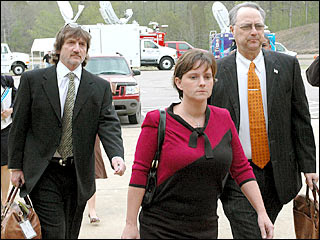
Mary Winkler, dressed demurely in a navy suit with a small cross around her neck, raised a crumpled tissue to her nose as Farese outlined the difficulties of her marriage.

After opening statements, Matthew Winkler's father, Dan Winkler, also a Church of Christ minister, testified that he talked to his daughter-in-law after her arrest. "I said, 'I am so sorry for all of this,' and I told her I wished I could take the handcuffs off and I could give her a big bear hug," he said.

But Mary, he said, never apologized to him. "She should have," he added.

Farese suggested that Dan Winkler, who now has custody of his three grandchildren and recently filed a $2-million wrongful-death lawsuit against Mary Winkler, had manipulated the three girls against their mother. Prosecutors expect to call the eldest daughter, who is 9, to testify about what she saw on the morning of the homicide.

Dan Winkler has refused to let his daughter-in-law see her children, Farese said.

"What's your personal feeling: Do you think Mary should see her children today?" Farese asked.

Dan Winkler stared into the distance for a few seconds, apparently struggling to formulate an answer, before Farese abruptly withdrew the question.

The trial is expected to take about two weeks. If convicted of first-degree murder, Mary Winkler could receive a life sentence. But the jury will also have the option of finding her guilty of a lesser charge.

jenny.jarvie@latimes.com


Copyright 2007 Los Angeles Times | Privacy Policy | Terms of Service
Home Delivery | Advertise | Archives | Contact | Site Map | Help

partners:

ARTICLE 2

http://www.latimes.com/news/nationworld/nation/la-na-wife14apr14,1,6154969.story

Interview with minister's wife played at trial

Mary Winkler sobbed and talked of reaching into a closet for a shotgun. She is charged in her husband's death.

By Jenny Jarvie
Times Staff Writer

April 14, 2007

SELMER, TENN. — Jurors in the trial of a minister's wife charged with first-degree murder heard a tape of her speaking in sobs during an interview with investigators the day after her husband's body was discovered in the parsonage.

"I didn't just get up and say, 'Hey, let's see how this thing works,' " said Mary Winkler, 33, apparently alluding to the shotgun used in the killing. "I was battling; I've been battling it not to do that forever. And I don't know why."

Winkler had recently been arrested at an Alabama resort about 340 miles from Selmer, the couple's western Tennessee hometown. She had been with their three young daughters.

An agent with the Alabama Bureau of Investigation was questioning her.

Winkler sobbed frequently in the recording. She said she reached up to get the shotgun from a closet and suggested she was in the bedroom, balancing on pillows on the floor, around the time of the shooting.

"It was not as loud as I thought it would be," she said.

But, as defense attorneys repeatedly pointed out, Winkler stopped short of saying she shot her husband, Matthew.

Many of her statements consisted of "um," "I don't know" and "uh-huh."

It was a "total blur," she said, when pressed to describe what happened immediately after the shooting.

Defense attorney Steven Farese suggested that Alabama agent Stan Stabler misled Winkler that her recorded statement would not be made public. He accused Stabler of pressing Winkler with increasingly loaded questions.

Farese also drew out the fact that Winkler did not verbally answer Stabler's repeated question of whether she shot her husband. "On the seminal issue in this case — whether Mary Winkler shot her husband — you say there was no verbal response?" Farese asked.

"With nodding, she affirmed to me," Stabler replied.

"Nodding?" said Farese theatrically. "Nodding?"

The defense, which is arguing that the shooting was accidental, suggested Winkler was tired and disoriented when she was interviewed. She paused for long periods of time, sobbed and asked for questions to be repeated.

"I just can't right now," she said when Stabler asked her to tell him what was troubling her. She said she was just not up to that.

Winkler suggested on the tape that the couple's domestic relationship had deteriorated after years of conflict, but she did not provide specifics.

She said repeatedly that she feared her husband's reputation would be smeared in newspapers and in court. Winkler, 31, was a minister at Selmer's 4th Street Church of Christ.

"There's no reason for him to have anything ugly because I have obviously done something very bad, so let me just, you know, be the, get the bad," she said.

Winkler took pains to speak well of her husband.

"He was a mighty fine person, and that's the thing," she said. "You just say, 'The lady was a moron.' " She added: "That's fine with me."

But she did reveal a few things about her husband.

"I love him dearly, but gosh, he just nailed me in the ground," she said. "Just chewing, whatever."

Winkler also said her husband had threatened her physically, referring to an incident six years ago when they lived in Pegram, Tenn.

"He said something that really scared me," she said. "I don't know, something life-threatening." She didn't elaborate.

In another interview, with a special agent of the Tennessee Bureau of Investigation named Chris Carpenter, Winkler talked of her husband's criticism of her, according to the interview summary Carpenter wrote. The interview wasn't taped.

Winkler said her husband criticized "the way I walked, what I ate, everything," according to the summary. She also mentioned financial pressures, which she described to Carpenter as "mostly my fault, bad bookkeeping."

"I was just tired of it," she was quoted as saying. "I guess I just got to a point and I snapped."

During cross-examination of Carpenter, defense attorney Leslin Ballin continued the argument that the state had insufficient evidence that Winkler deliberately shot her husband.

"You didn't write down that Mary pointed the shotgun at Matthew, did you?" Ballin asked. "You didn't write down that Mary intentionally pulled the trigger, did you?"

"She did not tell me she intentionally pulled the trigger," Carpenter replied.

jenny.jarvie@latimes.com

Saturday, March 17, 2007

Santa Barbara Gang Killing

So they say. School got out early last Wednesday. Kids from westside and eastside clashed on State Street by Saks Fifth Avenue. You can read the LA Times article below.

This isn't some big turning point for Santa Barbara. A few years ago on the main street on my side of town - Milpas - several guys ran back and forth through traffic shooting at each other like they'd just stepped out of a spaghetti Western. This shit happens, then it doesn't happen.

On the other hand, I don't know why people are so surprised. Santa Barbara schools are as crappy and thus as much like warehouses for kids with no future as the schools of any other town in California. People live two or three or more families to a house because, you'll be surprised to learn, you can't buy a Santa Barbara barrio house ($900,000 if you're lucky) on a barrio job ($15,000- 25,000 a year). I know, since I live in a barrio house only because I have a decent white-collar salary. People work three or four jobs to maintain even half or a third of a house, a detail from the story below that suggests that the structure of the California economy militates against basic parental supervision. No parents at home, no college future, no chance of moving out, no imagination of an interesting job, stuck on the vocational track, school as frustrating and humiliating, then a chance to stand up on State Street in mid-afternoon. The Sun Also Rises, anyone?

The article starts here:


http://www.latimes.com/news/local/la-me-gangkill16mar16,1,6411112.story
Deadly gang brawl stuns Santa Barbara
The city is reeling after violence erupts on the streets, leaving one teen killed and another charged with murder.

By Steve Chawkins
Times Staff Writer

March 16, 2007

SANTA BARBARA — Residents and tourists here were stunned Thursday in the wake of a daylight gang brawl that left a 15-year-old boy stabbed to death, a 14-year-old charged with his murder and downtown's main commercial strip shut down for more than eight hours.

"Everyone's saying, 'This isn't supposed to happen in Santa Barbara,' " said Police Chief Cam Sanchez. "Well, it isn't supposed to happen anywhere."

Police wouldn't reveal how the early Wednesday afternoon fight had started, saying it was still under investigation. But they were emphatic that the deadly skirmish, which involved throngs of participants and was witnessed by many bystanders, was a confrontation between two rival gangs.

Killed was 15-year-old Luis Angel Linares, a student at El Puente Community School who was known to his friends as Nacho. Bleeding after being stabbed, he staggered into the parking lot behind Saks Fifth Avenue on State Street before being rushed to a local hospital, where he was pronounced dead.

His alleged killer, whose name was not released because of his age, attended Santa Barbara Junior High School. He is being held at Santa Barbara County's juvenile hall, officials said.

Four others — allegedly members of the same gang — were also arrested on a variety of charges. They range in age from 13 to 16.

Santa Barbara students had been let out of school early Wednesday for a "minimum day" to give teachers and administrators time to attend training sessions, said J. Brian Sarvis, superintendent of the city's schools.

"We try to do the releases all at once so schools can coordinate with families that have child-care needs," he said. "Of course, we're rethinking that policy."

With the fight surging across State Street, dozens of police officers and sheriff's deputies converged on the scene from their departments' headquarters just blocks away. As it turned out, the Police Department was in the middle of a training session, so more officers were immediately available than would have been otherwise, officials said.

Behind Saks on Thursday afternoon, friends and classmates of the dead teen came by to pay their respects. Officers had removed the many candles and bouquets that had been left there, saying the boy's family did not want the site to become a flash point for further violence, police said.

With friends, 16-year-old Stephanie Montaldo was collecting donations for the Linares family in a hand-decorated cardboard box.

"I've known him since he was little," she said. "He was always very funny."

Blocks away, on the steps of the Police Department, Chief Sanchez said this was only the second gang-related death he could recall in his six years as head of the agency.

Although gangs have long been part of Santa Barbara's streetscape, Sanchez said he had been disturbed by their increasingly younger membership.

"The gang kids are getting younger and more blatant — more in-your-face with their teachers and even with officers," he said.

Meanwhile, parents, many of whom work multiple jobs to make ends meet, have been clamoring for solutions, he said.

"We have a gang unit, we have the Police Athletic League, we have a lot of things going on," Sanchez said, "but we can't force them into positive activities."

The fact that Wednesday's melee erupted so violently and in broad daylight was upsetting to many residents.

"I think some of these kids are numb to the fact of death," said Vincent Romero, a manager at the Unity Shoppe, a secondhand store on State Street that also provides clothing and groceries to the poor.

"It's video games, it's war, it's movies — it's just the whole package," he said.

Strolling into Saks on Thursday afternoon, Barbara Anderson, a recently retired program manager at UC Santa Barbara, said that, even a day later, the killing seemed incongruous.

"This is a safe town," she said. "When I read about this, my heart just broke."

*

steve.chawkins@latimes.com


Copyright 2007 Los Angeles Times | Privacy Policy | Terms of Service

Sunday, March 04, 2007

The Gang and the Globe

Sunday readers of The Los Angeles Times were treated today to twin headlines: "Smugglers Bring Havoc to Central America," and "How a Community Imploded." The piece on Central America describes governments' struggles against traffickers (those are Nicaraguan soldiers training their guns on captured smugglers) when parts of those governments are probably smuggling themselves. The other article is the best overview yet on the L.A. neighborhood "Harbor Gateway" and its major murder problem. This piece is good because it looks at causes besides the gangbangers themselves: unregulated apartment construction in the 1980s that, coupled with a total lack of public services (even streetlights, to say nothing of schools, parks, rec centers, and other gathering places), destroyed the community fabric. Most of the residents were low or limited income, the area became an immigrant community in which newcomers had to fend for themselves, sustaining barriers of language among others, and then the tripling of the black population in ten years created a backlash among some Latino kids. The article features some good material on the good life of a gang member - when it's better to be in than out - and also a very unusual phenomenon - a remorseful developer.

The story is sad - the 204th Street gang (Latino) has made most Black folks afraid to leave their houses during the day, and some of their kids have been gunned down in broad daylihgt. The story is infuriating - decent government, transitional services, and a public infrastructure can keep most of this from happening, but now it almost never does. In most parts of the US today, including California, government only reacts to crises and arrives on the scene when the bodies have been carted away to make a pious speech. L.A. abandoned Harbor Gateway long ago, and the result was avoidable fear and death.

Thursday, February 22, 2007

Role of Loss Confirmed

Some results of the Yale Bereavement Study confirm one of the Detective Fiction course's themes- the importance of loss in shaping behavior. An article in today's Los Angeles Times reports that the study "found that, contrary to common belief, yearning or missing a loved one is a more dominant emotion than depression - meaning mental health experts who treat the grief-stricken may need to refocus on feelings of loss."

Friday, January 19, 2007

It's Really Working, Isn't It?


The Governor's holiday gift to Californians was a proposal for an $11 billion expansion program of one sorry part of the state's overburdened infrastructure. Only problem was, it was for prisons. The prisons are in terrible shape - operating at double capacity, meaning the conditions for the prisons have been judged by federal courts to be illegal and they have warned the state they will be taken over if the state doesn't fix them. California also has the highest recidivism rate in the United States - and it's not a strong standard to start with. Schwarzenegger's proposal was for 73,000 new beds, or in other words to add 50% more prison beds to the number built between 1984 and 2004, which was the greatest prison building boom in world history. That didn't work, so let's do it again!

Crime is plastered all over the newspapers every day now, particularly in L.A., which is going through one of its regular gang crime booms (up 14% over 2005 citywide, up 25% in South L.A., and up 42% in the San Fernando Valley). Here's a sample of headlines just from the last 2 days. Enjoy the incoherence:
  • "Governor blames public indifference for prison ills" (Jan 18)
  • "DEA raids marijuana outlets" (Jan 18)
  • "L.A. urged to alter gang tactics" (Jan 18)
  • "Hate-crime case witnesses called heroes" (Jan 18)
  • "FBI joins L.A.policing effort in war on street gang crime"
  • "Anti-gang battle needs more than just cops"
  • "Democrats offer plan to overhaul sentencing"
These articles lay out the following picture. We spend a fortune on prisons and justice but we're supposed to spend more. Because we don't spend more, violent offenders get out on early release. But that doesn't really matter, because keeping them in makes them worse. It'll save money to shorten sentences so we'll do that. That contradicts our faith in prisons we'll spend billions more on them. As the gang problem gets press, politicians call for more cops. But more cops won''t solve the gang problem, which starts with a lack of jobs. But we can't create more jobs, because we have to build more prisons.

This machine doesn't help neighborhoods or young men. It's excellent, however, for juicing politicians.

The "more than cops" piece was written by the LA Times columnist Steve Lopez. Near the end of it, he says the true thing that the official crime talk of California politicians always avoids.
Although some gang members are sociopaths who need to be locked away for good, many are products of economic, educational, cultural and social forces that have destroyed families and communities. They grow up with absent dads and addicted moms in places where the manufacturing jobs of yesteryear gave way to a service economy that doesn't buy you a house and barely pays the rent.
"If you don't have a job for them, it's over," [Connie] Rice said about what happens if you're lucky enough to talk a kid out of a gang. "[Father] Greg Boyle is right. The only factor that has ever substantially reduced crime by gangs is jobs."
So jobs are the one thing politicians won't talk about. The "New Economy" and poverty go together, and together they produce gang crime. Sure it's "not that simple" - but it's 80% that simple. Problem is, admitting this would make folks like Schwarzenegger have to rethink their economic ideologies, in which zero government steering of the economy makes us all rich and free.

It's easier and cheaper for Arnold to get up there on autopilot and say we don't care about prisons enough to spend another $11 billion. That's not true. We the people just don't have the money Even if we did, we wouldn't waste it on more prisons that won't fix the economy but will destroy more lives.